
OWON DGE2035
4.2Editor score
35 MHz frequency range
14-bit resolution precision
PC control via USB
This guide compares ten top Amfm Signal Generator options for labs and hobbyists, highlighting frequency range, modulation types, and portability to help you
Finding the right Amfm Signal Generator is essential for anyone working in electronics, radio testing, or industrial calibration. These devices produce precise electrical signals that allow engineers and technicians to test circuits, troubleshoot systems, and verify performance under controlled conditions.
We evaluated ten models based on frequency range, modulation capabilities, build quality, and user feedback. Our analysis includes handheld units, benchtop generators, and specialized tools to ensure you find a solution that matches your specific technical needs and budget constraints effectively.
Each pick in this list showcases key strengths and potential limitations so you can make an informed decision. Prices and availability change frequently, so please verify the latest details on the product pages before placing your order to ensure you get the best value available today.
4.2Editor score

5.0Editor score

5.0Editor score
The following table provides a side-by-side comparison of all ten models featured in this guide. Use this overview to quickly identify which unit offers the specific frequency range, modulation types, and features required for your testing applications.




The UNI-T UTG962E stands out as a top choice for users needing a reliable Amfm Signal Generator. With a perfect rating from users, this handheld unit delivers high performance in a mini palm-sized package. Its dual-channel capabilities and wide modulation support make it ideal for diverse testing scenarios.
We may earn a commission when you buy through this link, at no additional cost to you.
This generator offers a 60 MHz frequency range with a 200 MS/s sample rate and 4Kpts memory depth. The included AM, FM, PM, and FSK modulations allow for complex signal analysis. Users appreciate the linear and logarithmic scan functionality which aids in comprehensive component evaluation.
While the 60 MHz limit might restrict ultra-high-frequency applications, the unit excels in general electronics work. The light weight and mini size ensure it fits easily into field kits. The cost-effective solution provides professional features without a steep price tag for enthusiasts.
Enthusiasts and professionals should consider this model for its balance of features and portability. It is perfect for tasks requiring precise signal generation with AM or FM modulation. The inclusion of BNC cables and power adapter makes it ready to use right out of the box.
The dual channel support allows simultaneous sine, square, or arbitrary waveform generation. This feature is crucial for testing differential circuits or comparing signal paths without switching devices.
Support for AM, FM, PM, and FSK modulation ensures compatibility with various radio and communication testing standards. Users can store non-volatile digital waveforms for repeated use.
We may earn a commission when you buy through this link, at no additional cost to you.
The OWON DGE2035 offers exceptional value for those seeking an Amfm Signal Generator on a budget. Rated well by users, it provides dual-channel output and 35MHz frequency capabilities. The 14-bit resolution ensures precise signal generation for lab testing and educational purposes.
We may earn a commission when you buy through this link, at no additional cost to you.
This unit features a 3.6-inch TFT LCD that displays real-time waveform status clearly. It includes standard waveforms and 150 arbitrary ones, plus advanced modulation like AM and FM. The PC control via USB makes it suitable for automated testing setups in research labs.
The 35MHz limit is suitable for most audio and radio applications but not for high GHz work. The ultra-thin design and shortcut keys improve portability and ease of operation. It remains a strong contender for students and engineers needing reliable waveform tools.
Educators and hobbyists will find this generator fits their needs without overspending. The sweep and burst functions add versatility for circuit validation. Its ability to handle remote control tasks makes it a smart addition to any connected testing bench setup today.
The color screen helps users visualize signal changes instantly. This clarity is vital when adjusting parameters during live troubleshooting sessions.
PC control allows for scripting and automated test sequences. This is useful for repetitive industrial testing or long-duration monitoring tasks.
We may earn a commission when you buy through this link, at no additional cost to you.
The SEESII Dual Channel is a premium Amfm Signal Generator designed for serious engineering work. With a perfect rating, it offers fully independent dual channels with continuous phase adjustment. The low distortion and high sampling rate ensure precise and repeatable test results.
We may earn a commission when you buy through this link, at no additional cost to you.
This generator integrates seven devices into one including a function generator and frequency meter. It features 60 built-in arbitrary waveforms and adjustable pulse widths for timing simulations. The 2.4-inch TFT LCD displays parameters clearly for easy configuration during complex tasks.
While limited to 30 MHz, its precision is unmatched in this range. The wide application scenarios cover R&D, factory inspection, and university labs. Users appreciate the inclusion of alligator clips and test cables in the complete package.
R&D engineers and technicians should choose this for high-quality signal simulation. The adjustable phase difference is vital for synchronous circuit testing. It saves desktop space and cost by replacing multiple instruments with a single robust unit.
Continuous phase adjustment from 0 to 359.9 degrees allows detailed differential circuit analysis. This feature is often found only on higher-end models.
By combining a generator, counter, and sweeper, this unit reduces clutter. It is ideal for compact workspaces where space is at a premium.
We may earn a commission when you buy through this link, at no additional cost to you.
The 6-Band Signal Generator provides a robust solution for RF testing up to 150MHz. While user ratings are not listed, its specs suggest strong performance for lab and maintenance work. The low phase noise ensures signal purity for high-quality environments.
We may earn a commission when you buy through this link, at no additional cost to you.
It features a metal and plastic build that resists scratches and corrosion. The wide frequency range is divided into six bands for easy selection. Simple operation with clear knobs helps users get started quickly without extensive manuals.
The assembly-free structure saves setup time significantly. It is suitable for environments requiring durable equipment that can withstand daily handling. The choice of AM or FM modulation allows for diverse signal generation needs.
Technicians maintaining electronic equipment will find this generator practical. Its sturdy design ensures longevity in field settings. Connecting the power supply and test clip is all that is needed to begin testing radio or audio systems immediately.
The metal housing protects internal components from damage. This durability is essential for generators used in workshops or field repairs.
The six-band division helps avoid frequency overlap issues. It allows precise targeting of specific radio frequencies during tuning tasks.
We may earn a commission when you buy through this link, at no additional cost to you.
The Upgraded RF Signal Generator offers an extensive range up to 4400MHz for RF applications. While user ratings suggest variability, it supports both single frequency and sweep modes for flexible testing. The sine wave output is suitable for basic signal needs.
We may earn a commission when you buy through this link, at no additional cost to you.
It includes power off memory to save parameters for future use. The kit is powered by mobile chargers or USB, making it highly portable. The frequency screen kit ensures users can track settings easily during adjustments.
The high frequency limit allows work on modern wireless systems. However, the limited waveform options might restrict complex testing. Users must weigh the range against the simplicity of the output features when selecting.
Field technicians needing broad RF coverage may appreciate this unit. Its ability to run on a power bank is great for remote work. It serves as a straightforward source for frequency checks where high fidelity is less critical.
Sweep mode allows testing across a range of frequencies. This helps identify resonant points in circuits without manual tuning.
USB power compatibility reduces reliance on wall outlets. This feature is crucial for mobile technicians working on site.
We may earn a commission when you buy through this link, at no additional cost to you.
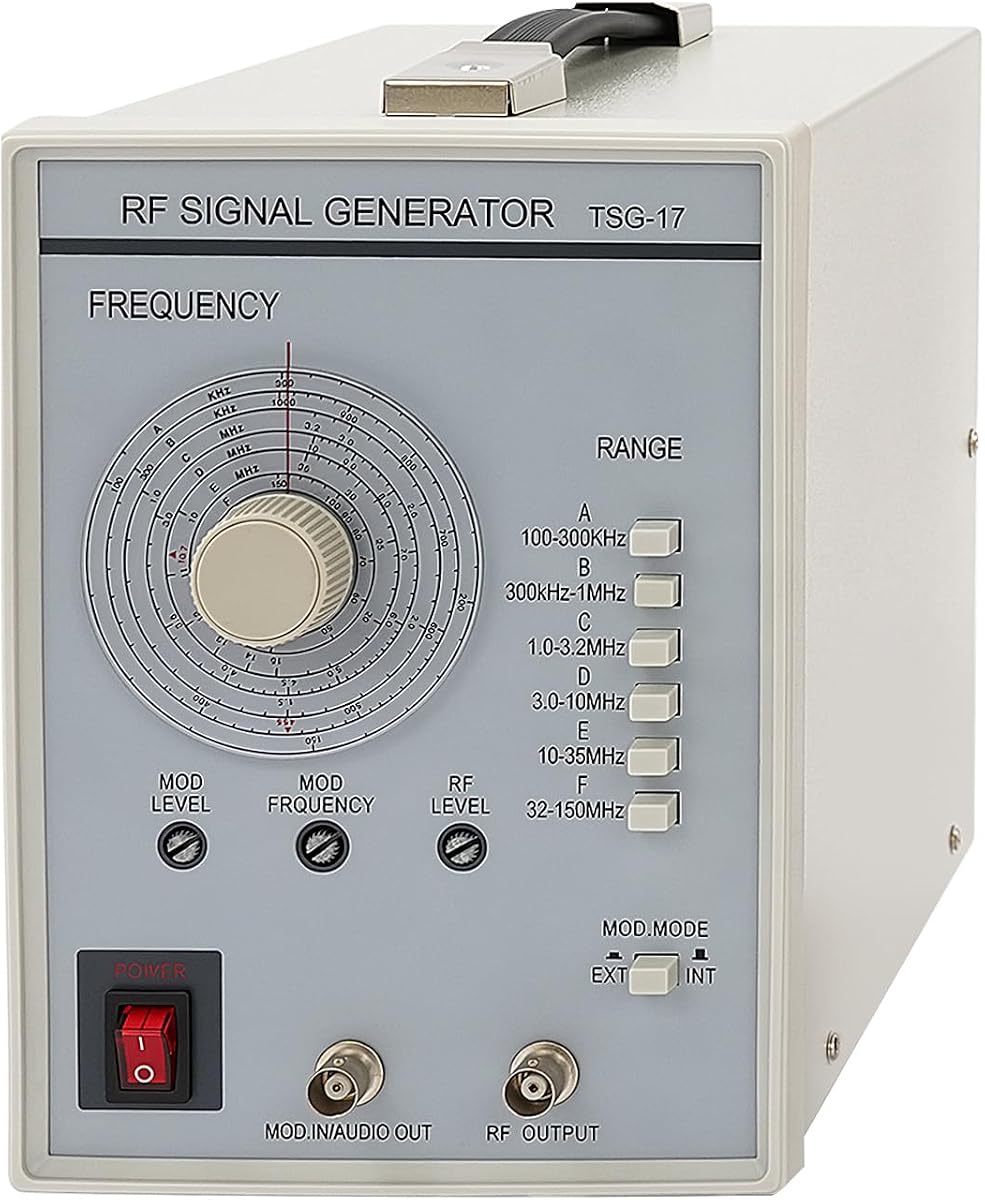
The TSG-17 High Frequency generator is designed for commercial and household use. It covers a frequency range from 100kHz to 150MHz with AM output options. High accuracy claims suggest it aims for precision in standard testing tasks.
We may earn a commission when you buy through this link, at no additional cost to you.
It supports external modulation signals from 50Hz to 20 KHz. The output control ranges from 1mV to 100m, providing adjustable signal strength. Harmonics up to 450MHz extend its utility for specific radio applications.
User ratings indicate potential inconsistencies or learning curves. However, the 110V power cord simplifies setup in fixed locations. It remains an option for users needing basic AM generation without complex digital features.
Household hobbyists might find this unit sufficient for simple repairs. The external modulation allows for custom testing scenarios. Buyers should verify current performance data before purchase to ensure it meets specific technical standards.
Adjustable output voltage allows safe testing of sensitive components. This prevents damage during initial circuit validation.
Harmonics up to 450MHz offer extended range for specific tests. This is useful for checking filter responses beyond the base frequency.
We may earn a commission when you buy through this link, at no additional cost to you.
This Adjustable Signal Generator focuses on process control signals like 4-20mA and voltage. It offers a built-in lithium battery for portable field use. Rated well by users, it ensures safety with short and reverse connection protection.
We may earn a commission when you buy through this link, at no additional cost to you.
The voltage output can be set between +/-12V with high accuracy. Current output ranges from 0-24mA which is standard for industrial loops. The PWM function allows frequency adjustments up to 150 kHz for versatile testing.
The battery provides 1-5 hours of operation depending on load. Calibration options ensure precision for critical measurements. It is ideal for checking PLCs and sensors that rely on analog signals.
Field technicians should choose this for loop testing without power access. Its compact size and battery life support remote work. Safety features prevent damage to equipment during calibration or maintenance tasks on site.
4-20mA simulation is key for transmitter verification. This generator mimics real sensor outputs for system checks.
Integrated battery ensures uninterrupted work in the field. It eliminates the need for external power packs during inspections.
We may earn a commission when you buy through this link, at no additional cost to you.
The Riiai 0-10V offers a 4-digit display for precise voltage and current control. It supports passive or active outputs which increases flexibility. The encoder knob allows smooth adjustment of values for accurate calibration.
We may earn a commission when you buy through this link, at no additional cost to you.
Users can set nine fast signal output points for quick access. The display modes include voltage, current, and percent formats. The built-in battery allows operation via micro USB or external DC power sources.
It is designed for PLC and panel debugging tasks. Short circuit and reverse protection ensure device safety. The high user rating reflects its reliability for daily industrial maintenance work.
Technicians working on automation systems will find this useful. The ability to switch modes quickly speeds up testing. It is a robust tool for verifying sensor outputs and actuator inputs in real time.
Multiple display options help visualize data in different units. This flexibility aids in interpreting results for various standards.
Support for both modes covers more device types. This compatibility reduces the need for multiple testing units.
We may earn a commission when you buy through this link, at no additional cost to you.
The Riiai SG003A supports multiple signal types including voltage current and pulse. A color TFT screen helps view real-time curves during adjustments. It includes a large battery for extended operation in the field.
We may earn a commission when you buy through this link, at no additional cost to you.
It features automatic modes for rising falling or cyclic changes. This allows simulation of dynamic signals without manual inputs. The PWM interface provides additional control over duty cycle and frequency.
The 3000mAh battery supports long work periods without charging. Users can store preset values for quick recall during tasks. It is ideal for complex PLC testing and industrial equipment maintenance.
Engineers need dynamic signal simulation should consider this unit. The auto modes streamline repetitive testing procedures. Its versatility makes it a strong tool for varied industrial control applications.
Automatic signal changes simulate real-world conditions. This helps validate system response to varying inputs.
Storing values speeds up common test routines. This feature improves efficiency in routine maintenance scenarios.
We may earn a commission when you buy through this link, at no additional cost to you.
The DROK 4-20mA Generator provides simple dual signal generation for analog testing. It uses a potentiometer for manual adjustment which simplifies operation. The unit supports both current and voltage outputs in one module.
We may earn a commission when you buy through this link, at no additional cost to you.
The compact design fits easily into pocket kits for repairs. It allows quick value adjustments for PLC panels or LED tests. The simplicity makes it suitable for basic calibration without complex setups.
While lacking digital displays, it offers direct control over outputs. The dual signal capability reduces the need for multiple devices. It is a practical choice for straightforward tasks where precision is secondary.
Users preferring analog controls will appreciate this model. Its ease of use is ideal for quick checks. It serves as a reliable backup tool for field service tasks involving basic analog signals.
Manual knobs offer tactile feedback during adjustments. This helps in fine-tuning without relying on digital menus.
A minimal interface reduces learning time significantly. New users can start working immediately without training.
We may earn a commission when you buy through this link, at no additional cost to you.
Selecting the right generator involves evaluating technical specs and usability. This guide breaks down key factors to help you narrow down your options effectively.
The frequency range determines which signals your generator can produce. For RF work, a range extending to hundreds of MHz is necessary. Ensure the unit covers the frequencies you need most.
Choose a model that meets your highest required frequency to avoid limitations later.
Modulation capabilities like AM or FM are critical for radio testing. Advanced users may need PM or FSK options. Check if the generator supports the specific modulations required for your applications.
Verify modulation features match your testing standards before purchasing.
Dual channel generators allow simultaneous output which saves time. Independent channels provide flexibility for differential testing. Consider if single channel is sufficient or if dual is needed.
Dual channels are beneficial for complex circuit analysis tasks.
Higher bit resolution ensures precise signal generation. Look for specs like 14-bit resolution to minimize distortion. Accuracy impacts the reliability of your test results significantly.
Prioritize high resolution for applications requiring exact measurements.
A clear display helps you configure parameters quickly. TFT screens with menus improve usability during adjustments. Ensure the interface is intuitive enough for your skill level.
Good display visibility is essential for efficient operation.
Field work requires portable units with battery power. Check weight and size to ensure it fits in your tool bag. Portability affects where you can use the generator.
Choose compact designs for mobile or remote testing needs.
USB or PC control allows automated testing sequences. Connectivity expands the generator to utility beyond manual inputs. Check if the model supports remote control requirements.
USB connectivity is useful for integrated lab setups.
Look for short circuit and reverse protection features. Safety protects both the generator and your DUT. Reliable units include these safeguards as standard.
Always ensure the generator has basic safety protections.
Before using, connect the generator to a stable power source. Ensure all cables are securely attached to the output ports. Set the initial frequency and amplitude settings according to your test requirements.
Regularly calibrate the unit to maintain accuracy over time. Use the display or PC software to verify output levels. Keeping the firmware updated ensures compatibility with modern systems.
Store the generator in a dry and dust-free environment. Avoid exposing it to extreme temperatures or humidity. Proper care extends the lifespan and reliability of your testing equipment.
Most radio testing applications require a range from 100KHz to 150MHz. High-end models may offer up to 4400MHz for specialized RF work. Choose based on the maximum frequency you need to generate.
Dual channels allow you to output different signals simultaneously. This is essential for differential testing and comparing two signal paths. It saves time and ensures synchronized testing without extra hardware.
Yes, many models support 4-20mA and voltage outputs for PLCs. Always check the specs to ensure compatibility with industrial standards. Some generators are specifically designed for process control loops.
Use the internal calibration feature if available or a reference meter. Check the manufacturer's guide for specific calibration steps. Regular calibration ensures your signal outputs remain accurate over time.
Yes, several units come with built-in rechargeable batteries. These are ideal for field work where power outlets are scarce. Check the battery life to ensure it meets your session duration needs.
Standard waveforms include sine square and triangle patterns. Arbitrary waveforms allow custom shapes for unique testing scenarios. Arbitrary options offer more flexibility for specialized engineering tasks.
Many models include basic cables like USB or BNC connectors. However, specialized adapters might need separate purchase. Always check the package contents before ordering to avoid missing accessories.
Look for USB connectivity and check software requirements. Many modern generators support virtual instruments or drivers. Verify the PC compatibility list provided by the manufacturer.
Choosing the right Amfm Signal Generator depends on balancing frequency range and features. Our top picks offer a mix of portability and performance for various needs.
Prioritize your primary tasks whether that is RF testing or PLC calibration. The right tool will save time and ensure accurate results in your work.
Always verify the latest pricing and availability before purchase. Technology evolves quickly and stock levels change often for these specialized units.