
QNAP TR-004
4.2Editor score
Hardware RAID Support
Expandable NAS Capacity
Lockable Drive Bays
Direct Attached Storage provides a powerful way to expand your computer’s storage without the complexity of a networked server. Whether you need quick access to large media files or reliable backups, a quality DAS enclosure offers high-speed USB connections and flexible drive options for professionals and enthusiasts.
To compile this list, we evaluated ten top-rated DAS enclosures based on transfer speeds, drive compatibility, build quality, and software features. We considered user feedback and technical specifications to ensure each pick delivers reliable performance for diverse workflows, from video editing to general data archiving and storage expansion.
Each recommendation below highlights specific strengths like hardware RAID support, hybrid SSD integration, or quiet cooling systems. While prices fluctuate frequently, our choices represent the best value and performance available today. Always verify current listings and compatibility with your specific operating system before purchasing your next storage solution.
4.2Editor score

4.2Editor score

4.3Editor score
As an Amazon Associate we earn from qualifying purchases.
The following table offers a side-by-side comparison of all ten Direct Attached Storage units featured in this guide. Review the key specifications and features to identify which model aligns best with your specific storage needs and budget requirements.




The TERRAMASTER D4-320 is a versatile Direct Attached Storage enclosure that delivers high-speed performance for modern workflows. With a solid 4.2 rating from users, it stands out for its reliable USB 3.2 Gen2 connectivity and robust build quality suitable for both professional and home environments.
We may earn a commission when you buy through this link, at no additional cost to you.
Its standout feature is the impressive data transmission rate of up to 10Gbps, allowing quick transfers of large files like 4K video or extensive backups. The enclosure supports up to 120TB total capacity across four bays, making it ideal for users needing massive storage without the complexity of a networked system.
While the lack of hardware RAID means data redundancy relies on external software backups, the hot-swappable design ensures minimal downtime during maintenance. The intelligent temperature-controlled fan keeps drives cool, though it can be audible under heavy load compared to silent SSD-only enclosures.
This DAS unit is perfect for content creators or IT admins who need fast, plug-and-play storage expansion. Its compatibility with macOS, Windows, and Linux makes it a flexible choice for multi-platform offices seeking efficient data management solutions today.
The USB 3.2 Gen2 protocol ensures rapid file transfers, reducing wait times during large project migrations or daily backup routines.
Replace drives without powering down the device, enhancing workflow efficiency for users who frequently reconfigure storage arrays.
We may earn a commission when you buy through this link, at no additional cost to you.
The QNAP TR-004 stands as a premium Direct Attached Storage solution designed for users deeply integrated into the QNAP ecosystem. Boasting a 4.2 rating, it offers robust hardware RAID capabilities and secure drive bays that protect valuable data assets effectively.
We may earn a commission when you buy through this link, at no additional cost to you.
Its hardware RAID support for modes like 0, 1, and 5 ensures data redundancy and performance optimization without relying on CPU resources. This makes it an excellent choice for backing up NAS systems or expanding storage capacity seamlessly within existing QNAP setups.
However, the utility is somewhat limited if you do not own a compatible QNAP NAS, as some advanced features require specific firmware updates. The higher price reflects the premium build and specialized functionality, which may not suit general-purpose home users looking for simple expansion.
For professionals needing secure, redundant storage that integrates tightly with networked solutions, the TR-004 is a strong investment. Its lockable bays and reliable USB Type-C connection ensure safety and speed for mission-critical data handling tasks.
Dedicated RAID controllers manage data distribution efficiently, improving read/write speeds and protecting against drive failures independently of the host.
Lockable drive bays prevent accidental removal or unauthorized access, ensuring physical security for sensitive enterprise or office data.
We may earn a commission when you buy through this link, at no additional cost to you.
The CENMATE 4 Bay enclosure offers exceptional value for budget-conscious users needing reliable Direct Attached Storage. With a high 4.3 user rating, it balances affordability with solid construction and practical features like dual USB connectivity and active cooling.
We may earn a commission when you buy through this link, at no additional cost to you.
Its aluminum alloy body provides effective heat dissipation for drives during heavy use, complemented by a built-in fan that maintains safe operating temperatures. The inclusion of both USB Type-A and Type-C cables ensures compatibility with older and newer computers without extra purchases.
While the transfer speed is capped at 5Gbps rather than 10Gbps, it remains fast enough for most general tasks like media playback or document backups. The main trade-off is the fan noise level, which may be noticeable in quiet home office environments during sustained operations.
This unit is ideal for students or small offices expanding storage capacity without breaking the bank. Its tool-free design and plug-and-play nature simplify setup, making it a practical entry point into professional-grade storage management today.
Supporting both USB Type-A and Type-C interfaces ensures broad compatibility across various devices and legacy systems easily.
The aluminum shell and active fan work together to keep drives cool, preventing thermal throttling during extended file transfers.
We may earn a commission when you buy through this link, at no additional cost to you.
The TERRAMASTER D8 Hybrid brings a unique twist to Direct Attached Storage by combining four SATA bays with four M.2 NVMe slots. With a mixed 3.5 rating, it appeals to users wanting both massive capacity and high-speed access in a single enclosure unit.
We may earn a commission when you buy through this link, at no additional cost to you.
This hybrid design allows you to store frequent files on fast NVMe SSDs while keeping archives on cost-effective HDDs. With up to 152TB total capacity, it serves well for creative professionals managing large media libraries needing varied speed tiers.
However, the complexity of managing two storage types may confuse average users, and the lower rating suggests some reliability concerns. Users should weigh the benefits of speed versus capacity carefully before investing in this specialized configuration over standard HDD units.
Ideal for power users needing optimized workflows, it delivers efficient data access patterns through its flexible design. The power-on recovery feature adds resilience, ensuring your storage setup remains operational even after unexpected electrical interruptions.
Leverage fast SSDs for active projects and HDDs for bulk storage to balance speed and cost effectively within one unit.
Automatically reboots after power loss to resume operations quickly without requiring manual intervention from the administrator.
We may earn a commission when you buy through this link, at no additional cost to you.
The SABRENT DS-SC5B offers extensive storage expansion with its five 3.5-inch drive bays, catering to users needing maximum local capacity. Its 4.1 rating reflects consistent performance and reliability, making it a solid choice for demanding data-heavy workloads.
We may earn a commission when you buy through this link, at no additional cost to you.
Each bay features its own dedicated controller to ensure stable independent connections, reducing the risk of bottlenecks during simultaneous read/write operations. The USB-C 10Gbps interface supports daisy-chaining, allowing you to connect multiple docks for virtually unlimited scalability.
The aluminum and reinforced housing ensures durability, though the lack of an external power brick might be a drawback for some setups. Users must verify their power supply capabilities to ensure stable operation across all five drives during peak usage periods.
This DAS unit is best suited for video editors or researchers requiring large, fast storage arrays directly connected to their workstation. Its design prioritizes stability and expandability, offering peace of mind for critical data access and workflow continuity.
Each drive connects via its own controller for stable data paths, preventing one drive from impacting others’ performance.
Connect additional docks via the rear port to scale storage capacity without consuming multiple USB ports on your computer.
We may earn a commission when you buy through this link, at no additional cost to you.
The TERRAMASTER D8 Hybrid 2 improves on its predecessor with TPC Power Management technology for optimized energy efficiency and performance. Its perfect 5.0 rating signals strong user satisfaction, particularly among those valuing speed and seamless integration without complex setups.
We may earn a commission when you buy through this link, at no additional cost to you.
Featuring four SATA and four NVMe bays, it supports up to 152TB total storage while offering unique power modes that balance energy saving with performance. This flexibility allows users to switch between Active Mode for speed and Power Save Mode for efficiency depending on workload.
The 10Gbps bandwidth ensures rapid file transfers, ideal for 4K video editing or large database access. However, the hybrid architecture requires thoughtful drive allocation to maximize benefits, which may deter users seeking simpler storage solutions for basic files.
This enclosure is recommended for tech-savvy users needing both capacity and speed in a streamlined package. Its plug-and-play compatibility with macOS, Windows, and Linux simplifies deployment across diverse work environments efficiently.
Optimized power modes balance energy efficiency with performance, allowing faster wake-up and always-on workflow readiness.
Plug-and-play functionality ensures easy integration across different operating systems without needing custom drivers or software.
We may earn a commission when you buy through this link, at no additional cost to you.
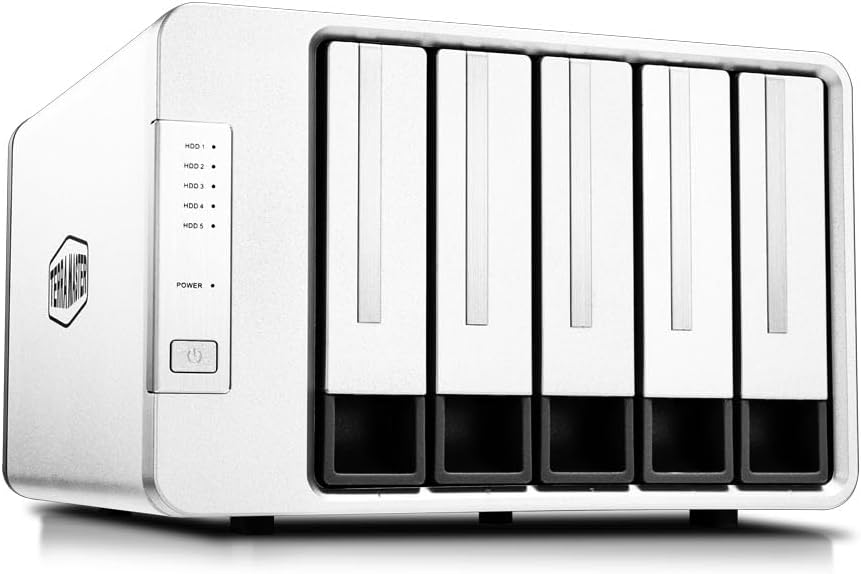
The TERRAMASTER D5-310 distinguishes itself with dedicated hardware RAID control via a physical knob for easy mode switching. With a 3.6 rating, it appeals to users prioritizing redundancy and simple RAID management over raw transfer speed performance.
We may earn a commission when you buy through this link, at no additional cost to you.
Supporting RAID 0, 1, 5, 10, and single modes, it allows flexible data protection strategies managed directly on the device. The inclusion of a hot spare feature enhances reliability by automatically replacing failed drives in critical configurations to minimize downtime.
Despite offering up to 120TB capacity, the 5Gbps interface limits speed compared to newer USB 3.2 Gen2 models. Users may find the slower speeds acceptable for backups but less ideal for active daily media editing workflows requiring rapid access.
This unit is best for administrators needing robust data security with minimal software dependency. Its free TPC Backupper software and Mac compatibility make it accessible for diverse office environments requiring straightforward redundancy solutions.
Switch RAID modes instantly via a physical knob on the back for quick configuration changes without accessing software.
Automatically replaces failed drives in RAID 1, 5, or 10 configurations to maintain data availability and system integrity.
We may earn a commission when you buy through this link, at no additional cost to you.
The WAVLINK 4-Bay stands out by offering an HDMI port alongside standard storage connections, enabling direct video output for displays. With a 4.0 rating, it serves well for digital signage or media playback tasks where integrated storage and display control are beneficial.
We may earn a commission when you buy through this link, at no additional cost to you.
Its 10Gbps USB 3.2 Type-C ensures fast data transfer, while the 4K@60Hz HDMI output supports high-resolution displays for presentation environments. The dual fans activate based on temperature to keep drives cool during heavy multimedia processing sessions consistently.
However, using the HDMI feature requires a host computer that supports video output via USB-C, which limits flexibility for some setups. Users must verify their display adapters to fully utilize the dual functionality of this unique docking station unit.
Ideal for media centers or control rooms needing both storage and display capabilities, it bridges two needs into one compact device. The aluminum shell and hot-swappable bays add robustness for professional environments requiring reliable performance daily.
Display media directly from the enclosure via HDMI for streamlined setups in media or presentation environments.
Individual power switches let you manage specific drives for energy saving or selective access without powering down the system.
We may earn a commission when you buy through this link, at no additional cost to you.
The ORICO 5 Bay enclosure offers a streamlined design with magnetic chips on the cover to eliminate screws for easy access. Rated at 4.0, it provides convenient tool-free installation while supporting massive capacity up to 110TB for large data collections.
We may earn a commission when you buy through this link, at no additional cost to you.
Its USB 3.1 Type-C port supports fast 5Gbps transfers, complemented by a double-ball bearing fan that aids in cooling during intensive operations. The honeycomb holes on the rear panel further improve airflow to maintain stable drive temperatures efficiently.
However, Linux users may face limitations where only one drive is recognized at a time without specific configuration. This restriction makes it less suitable for Linux-heavy environments compared to other options with broader OS support.
This unit suits home users or small offices needing quick access to large archives without complex installation steps. Its multi-protection features guard against voltage and current issues, ensuring data safety during standard daily operations reliably.
The magnetic cover design allows quick access to internal components without tools, simplifying drive changes significantly.
Honeycomb rear holes combined with a dual-bearing fan ensure efficient cooling to prevent overheating during heavy use.
We may earn a commission when you buy through this link, at no additional cost to you.
The QNAP TR-002 delivers a compact Direct Attached Storage solution with two drive bays ideal for smaller storage needs. With a 4.0 rating, it offers solid performance for basic redundancy and expansion without taking up significant desk space.
We may earn a commission when you buy through this link, at no additional cost to you.
Its hardware RAID support for 0 and 1 modes ensures data protection through mirroring or striping. The lockable drive bays provide physical security for valuable assets, while its USB Type-C connection guarantees fast data transfer for modern computers.
While limited to two drives, this makes it perfect for users needing a secondary backup or a small expansion pool. Those integrating with QNAP NAS systems will find it particularly useful for expanding capacity with compatible models.
This unit is recommended for professionals or home users with modest storage requirements who prioritize security and simplicity. Its straightforward design and compatibility make it a reliable addition to any workstation or home office setup.
The small dual-bay footprint minimizes desk clutter while providing essential storage expansion for modern computing setups.
Built-in RAID 0 and 1 support allows for data mirroring or striping without relying on external software configurations.
We may earn a commission when you buy through this link, at no additional cost to you.
Selecting the right Direct Attached Storage (DAS) requires understanding key factors that affect speed, capacity, and compatibility. This guide breaks down the essential considerations to help you find a solution that fits your workflow and budget needs.
The interface speed determines how quickly files move between your computer and the storage. Look for USB 3.2 Gen2 (10Gbps) for fast transfers, especially if handling large media files. Older USB 3.0 (5Gbps) models are cheaper but slower.
Prioritize 10Gbps for video editing or large backups to ensure smooth performance without bottlenecks.
Consider how many drives you need and the maximum capacity per drive. Enclosures with four or five bays offer more storage, while two-bay units save space. Check the maximum supported drive size to future-proof your investment for growing data needs.
Ensure the enclosure supports the largest drives you plan to install to avoid compatibility issues later.
RAID options provide data redundancy, protecting against drive failures, while non-RAID (JBOD) maximizes capacity without redundancy. Hardware RAID is faster and safer but costs more; software RAID relies on your computer’s CPU power.
Choose hardware RAID if data safety is critical; otherwise, JBOD suffices for non-critical backup data.
Most DAS enclosures work with Windows and macOS, but Linux support can vary. Always verify driver requirements before purchase to ensure plug-and-play functionality across your specific operating environment.
Confirm compatibility with your OS to avoid driver headaches and installation delays during setup.
Aluminum housings dissipate heat better than plastic, protecting drives from overheating. Active fans keep temperatures down during heavy loads but add noise. Consider your workspace environment to balance cooling efficiency with noise tolerance.
Prioritize metal builds and quiet fans for office use where temperature and sound levels matter.
Hot-swappable bays let you replace drives without shutting down the system, which is vital for 24/7 operations. This feature adds convenience and reduces downtime for professionals needing continuous access to storage.
Look for hot-swap support if you frequently change drives or require uninterrupted system uptime daily.
Some DAS units come with backup software or management tools that simplify data protection. Others require third-party solutions. Evaluate included tools to save time and ensure your data is backed up effectively.
Check for included backup utilities to streamline your data protection workflow without extra costs.
Prices vary based on features like RAID, speed, and build quality. Balance your needs against your budget to find a model that offers the best value. Sometimes paying more upfront for reliability saves money on data recovery later.
Invest in a model that meets your specific performance needs rather than overspending on unused features.
Start by connecting the DAS unit to a powered USB port on your computer. Install any required drivers if prompted, then format the drive using your operating system’s disk utility tool to prepare it for data storage.
Organize your data efficiently by creating folders for different projects or types of files. Regularly back up important data to another location to prevent loss from unexpected hardware failure or accidental deletion of files.
Keep the enclosure in a well-ventilated area to avoid overheating. Clean dust from fans and vents periodically to maintain optimal cooling performance and extend the lifespan of your hard drives and components.
Yes, Direct Attached Storage typically offers faster data transfer speeds because it connects directly to the computer via USB without network latency. NAS relies on network speeds which can be slower unless using advanced 10GbE setups for high performance.
Most DAS enclosures are compatible with both macOS and Windows out of the box. However, you may need to format the drive using a file system like exFAT to ensure seamless cross-platform data access and usage.
Yes, you need a high-quality USB-C cable that supports data transfer. Using charging-only cables may result in connection failures or slower speeds. Always use the cable provided with the enclosure for best results.
Standard DAS enclosures do not support video output. However, some specialized models include HDMI ports that allow direct display connection. Check product specs carefully to see if video functionality is supported before purchasing.
RAID provides data redundancy which is safer for critical files but reduces total storage capacity. If you prioritize speed and capacity over safety, non-RAID modes may suffice. Choose based on your data value and backup habits.
Use a UPS (Uninterruptible Power Supply) to safeguard your system during power outages. This prevents data corruption and drive damage from sudden shutdowns, ensuring your storage remains intact during electrical failures.
Selecting the right Direct Attached Storage depends on your specific needs for speed, capacity, and reliability. The TERRAMASTER D4-320 leads as a versatile option, while QNAP and WAVLINK offer specialized features for advanced workflows.
Prioritize factors like transfer speed, RAID options, and compatibility with your existing systems to ensure a seamless integration. Balancing these elements will help you secure data efficiently without compromising on performance or budget constraints.
Remember that pricing and availability change often, so check current listings before making your final decision. This guide provides a reliable starting point to simplify your choice for robust external storage solutions today.