4.9Editor score
In this guide
Apochromatic refractors deliver sharp high contrast views with minimal color fringing making them ideal for serious astronomers and astrophotographers seeking clarity.
We compared ten models based on glass quality optical design build quality and versatility to help you find the right scope for your imaging or visual needs.
Each pick highlights key strengths and tradeoffs so you can choose confidently while noting that availability and pricing may vary over time.
Top 3 Picks for Best Apochromatic Refractors
4.5Editor score
Top 10 Best Apochromatic Refractors in 2026 Compared
The following table provides a side-by-side look at each model to help you quickly compare key optical and mechanical characteristics.
1. SVBONY SV550 AP0 – Best Overall Apochromatic Refractor
This APO OTA apochromatic refractor stands out for its ability to reveal celestial wonders with minimal color fringing and high contrast.
Pros
- Eliminates chromatic aberration
- High-contrast bright images
- Lightweight magnesium construction
- Excellent for galaxies
- Simple difficulty factor
Cons
- Limited to OTA only
- Requires separate accessories
We may earn a commission when you buy through this link, at no additional cost to you.
Its triplet optics structure uses S-FPL51 ED glass and correction glass to virtually eliminate chromatic aberration resulting in sharp bright images.
The magnesium alloy focus mount reduces weight and vignetting while internal extinction barriers ensure clean views for deep sky targets like M42.
Ideal for observers and imagers seeking an affordable yet high-performance 80mm refractor OTA that delivers professional results without bulk.
Superior Chromatic Aberration Control
The air-spaced triplet design ensures that blue edge issues common in single ED structures are effectively managed for crisp imaging.
Lightweight and Portable Design
Magnesium alloy components cut down on overall weight making it easier to carry and mount on various telescope platforms.
We may earn a commission when you buy through this link, at no additional cost to you.
2. Explore Scientific ED80 – Best for High Contrast Views
This refractor uses genuine FCD1 HOYA ED glass and multi-layer coatings to produce stunning views filled with detail across various targets.
Pros
- Brilliant high-contrast views
- Great for photography
- Portable and compact
- Precision collimation system
- USA support available
Cons
- Heavier than some peers
- Dew shield may extend length
We may earn a commission when you buy through this link, at no additional cost to you.
Its air-spaced triplet design eliminates chromatic aberrations making it great for capturing images of the Moon planets and bright deep sky objects.
With a 480mm focal length and retractable dew shield it is highly portable for spontaneous stargazing or guiding duties on larger scopes.
Observers who value crisp detail and reliable American customer service will find this Essential Series model a solid choice for astronomy.
Excellent Optical Coatings
Proprietary enhanced multi-layer coatings on all optical surfaces maximize light transmission and reduce internal reflections for clearer images.
Precision Collimation
The front cell features push-pull adjustments ensuring the tightest stars possible for both visual and imaging applications.
We may earn a commission when you buy through this link, at no additional cost to you.
3. SVBONY SV550 Bundle – Best Kit for Imaging
This bundle pairs the SV550 APO OTA with a dedicated field flattener to ensure flat field imaging for both half-frame and full-frame sensors.
Pros
- Perfect 55mm back focal
- Reduces weight via magnesium
- Supports full-frame cameras
- High-quality extinction measures
- Easy accessory integration
Cons
- Includes only specific adapter
- May need more mounting hardware
We may earn a commission when you buy through this link, at no additional cost to you.
The magnesium alloy focus seat reduces load significantly while internal extinction barriers provide ultimate light control for deep sky targets.
An 180mm dovetail plate with hollow design makes setup easier and allows diverse accessory choices for mounting guide scopes or cameras.
Photographers looking for a ready-to-use setup that corrects field curvature will appreciate the seamless integration and optical performance.
Optimized Back Focal Length
The package includes extension tubes and adapter rings to ensure the conventional 55mm back focal length is maintained for flat fields.
Magnesium Weight Reduction
The focusing seat material cuts weight by over twenty percent compared to standard aluminum improving portability and balance.
We may earn a commission when you buy through this link, at no additional cost to you.
4. SVBONY SV550 122mm – Best Premium Aperture
This 122mm aperture refractor gathers more light than smaller models enabling clearer detailed images and access to fainter deep sky objects.
Pros
- Large aperture capability
- Clear detailed images
- Lightweight for size
- Easy handle transport
- Simple guide scope install
Cons
- Higher price point
- Requires stable mount
We may earn a commission when you buy through this link, at no additional cost to you.
It uses a FPL-51 triplet structure to correct aberrations reduce chromatic issues and enhance sharpness for both photography and visual use.
A portable handle on the dovetail base makes moving this large aperture telescope easy and safe when fitting into carrying cases.
Advanced astronomers who need higher limiting magnitude and portability will find this model an excellent investment for serious observing.
Large Aperture Advantage
The 122mm design provides superior light gathering allowing for better observation of fainter deep sky targets compared to 80mm options.
Convenient Transport Handle
The integrated handle on the SV211 dovetail base allows for comfortable carrying without needing additional accessories.
We may earn a commission when you buy through this link, at no additional cost to you.
5. Askar 71F – Best Budget Apochromatic Refractor
The Askar 71F balances practicality and versatility with an extremely light weight making it easy to carry and use for various observations.
Pros
- Extremely lightweight design
- Affordable high quality
- 360 degree rotation
- Versatile for visual and photo
- Easy to carry
Cons
- Smaller aperture
- May need external flattener
We may earn a commission when you buy through this link, at no additional cost to you.
Its quadruplet air-spaced APO design and matte painted interior reduce stray light and color fringing for clear sharp visual and photo views.
The focus can rotate 360 degrees for convenient composition without tube rotation and it works well for both astronomy and bird watching.
Budget conscious observers and photographers seeking a versatile self-flattened OTA that is easy to transport will find this model ideal.
Incredibly Lightweight Build
Weighing only 2.5 kilograms without accessories this telescope is easy to transport for spontaneous stargazing sessions.
Flexible Composition
Loosening screws allows full 360 degree rotation of the focus for perfect framing without moving the entire mount.
We may earn a commission when you buy through this link, at no additional cost to you.
6. SVBONY SV503 – Best for Visual and Photography
This 102mm aperture telescope delivers brighter higher-contrast images with FMC coatings and ED glass to minimize color fringing for detail.
Pros
- Superior optics quality
- Reduced chromatic aberration
- 360 field rotator
- Aluminum retractable hood
- True-to-life color
Cons
- Requires separate mount
- Dew shield is large
We may earn a commission when you buy through this link, at no additional cost to you.
Its dual-speed focuser and 360-degree field rotator allow perfect camera alignment and critical focus effortlessly for various photography setups.
The aluminum retractable hood blocks stray light prevents dew and protects the lens while offering 90mm focus travel for accessories.
Adult astronomers seeking a powerful large diameter refractor that excels at both planetary and deep-sky work will appreciate its clarity.
Advanced Focuser System
The 360-degree field rotator eliminates the need to rotate the tube for camera alignment making setup significantly easier.
Robust Protection
A 133mm retractable hood actively blocks stray light and prevents dew formation to keep optics clear in humid conditions.
We may earn a commission when you buy through this link, at no additional cost to you.
7. SVBONY SV550 APO Bundle – Best for Wide Field Imaging
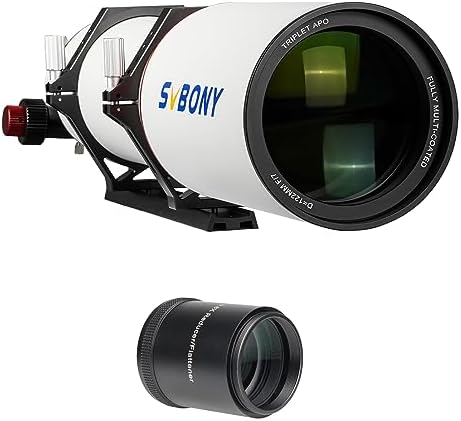
This bundle pairs the 122mm APO refractor with a dedicated 0.8X focal reducer field flattener specifically designed for prime focus astrophotography.
Pros
- Large 122mm aperture
- Includes focal reducer
- Corrects field defects
- Wider field of view
- Suitable for enthusiasts
Cons
- Higher cost package
- Requires precise setup
We may earn a commission when you buy through this link, at no additional cost to you.
The SV209 accessory corrects field curvature defects improving image quality and shooting efficiency at the edge of the field of view.
The telescope features an FPL-51 triplet lens that reduces chromatic aberration and enhances clarity and sharpness for deep sky work.
Photographers wanting both a large aperture and a wider field of view without buying separate reducers will find this bundle efficient.
Field Flattening Power
The included SV209 flattener corrects defects ensuring stars remain sharp across the entire image frame for better astrophotography.
Wider Field Advantage
The 0.8X reducer provides a wider field of view making it easier to capture larger targets and improve framing options.
We may earn a commission when you buy through this link, at no additional cost to you.
8. SVBONY SV550 122mm Kit – Best Full Imaging Kit
This kit offers a complete 122mm imaging solution with the SV209 focal reducer and field flattener ready for prime focus astrophotography.
Pros
- Large aperture imaging
- Focal reducer included
- Easy carry design
- High image quality
- Faint target capable
Cons
- Heavy for travel
- Setup complexity
We may earn a commission when you buy through this link, at no additional cost to you.
It gathers more light for clearer detailed images and fainter deep sky targets thanks to the FPL-51 triplet apochromatic lens structure.
The portable handle on the dovetail base ensures this large aperture telescope can be easily carried and moved without extra tools.
Serious astrophotographers wanting a fully equipped kit that maximizes aperture and field correction should consider this comprehensive bundle.
Complete Imaging Solution
The included accessories ensure you have everything needed to start imaging deep sky objects right away without extra purchases.
Portability Features
Despite the larger aperture the handle and dovetail design make moving the scope manageable for various observing locations.
We may earn a commission when you buy through this link, at no additional cost to you.
9. SVBONY SV550 80 Kit – Best Compact Kit
This 80mm kit pairs the triplet APO refractor with a dedicated field flattener to address fringe field curvature for better image quality.
Pros
- Compact and portable
- Field flattener included
- Bright clear images
- Comfortable handle
- Simple difficulty factor
Cons
- Limited accessory range
- Inverted image normal
We may earn a commission when you buy through this link, at no additional cost to you.
Sharp wide band fully multilayer coated lenses prevent irritating reflections and deliver bright clear images for visual and imaging use.
Observing targets like M42 and M45 is simple with this setup and the comfortable carrying handle improves safety during installation.
Observers needing a portable yet high quality imaging package that corrects field issues will appreciate the convenience and optical clarity.
Flattener Integration
The included SV209 flattener is specifically matched to the SV550 80F6 OTA to fix edge curvature issues efficiently.
Safety and Transport
The adjustable carrying handle allows for safe and easy transport while making setup safer for any telescope platform.
We may earn a commission when you buy through this link, at no additional cost to you.
10. SVBONY SV550 Camera Kit – Best Guiding Kit
This bundle offers a complete imaging package pairing a 122mm APO refractor with a compact highly sensitive guiding camera for autoguiding.
Pros
- Large aperture imaging
- Includes guiding camera
- Bright detailed images
- Tight tracking stars
- Compact guide scope
Cons
- Limited to specific camera
- Requires power sources
We may earn a commission when you buy through this link, at no additional cost to you.
The 1.23-megapixel color camera with 1/3 CMOS sensor allows tight tracking of faint guide stars with high peak QE and low noise.
The refractor gathers more light for detailed images suitable for deep sky photography while the guide scope and camera ensure precision.
Astronomers seeking a ready-to-use kit with integrated guiding solutions will find this bundle excellent for accurate long exposure work.
Precision Guiding Performance
The SV905C camera features 3.75-micron pixels and high peak QE allowing it to track faint guide stars effectively for tight tracking.
Large Aperture Imaging
The 122mm aperture gathers significant light making it suitable for fainter deep sky objects and detailed photography sessions.
We may earn a commission when you buy through this link, at no additional cost to you.
Buying Guide – How to Choose the Best Apochromatic Refractor
Choosing the right apochromatic refractor involves balancing optical performance portability and specific imaging or visual needs.
Aperture Size
Aperture determines how much light the telescope gathers which directly impacts your ability to see faint deep sky objects. Larger apertures provide more detail and better resolution but add weight and cost. For astrophotography consider models with 80mm to 122mm aperture depending on your mount capacity.
Prioritize aperture based on your specific targets and portability requirements to ensure optimal balance between performance and ease of use.
Optical Design
APO refractors use triplet or quadruplet designs with ED glass to eliminate chromatic aberration. Look for air-spaced designs with S-FPL51 or FCD1 HOYA glass for the best color correction. These structures ensure sharp bright images with minimal color fringing at the edges of stars.
Verify that the optical design matches your imaging goals to avoid issues like field curvature or color blur in your photos.
Focal Length and Ratio
Focal length and ratio affect your field of view and exposure times. Shorter focal ratios like f/5 to f/7 are ideal for wide field imaging while longer ones suit planetary work. Check that the back focal length fits your camera and accessories easily.
Select a focal length that provides the field of view you need for your target objects without requiring excessive extension tubes.
Mounting and Portability
Portability matters if you travel to dark sky sites. Look for lightweight alloys like magnesium and integrated handles on dovetail bases. Ensure the telescope fits your existing mount or tripod without overloading it which causes tracking errors.
Choose a design that balances light gathering power with a weight your mount can support stably for long exposures.
Accessories Included
Bundles often include field flatteners focal reducers or guide cameras which save time and money. Check if the package has what you need for your camera type. Missing key accessories can add extra costs and setup complexity later.
Confirm that included accessories match your sensor size and imaging requirements before purchasing to avoid additional buys.
Focuser Quality
A smooth dual-speed focuser with sufficient travel allows precise focus even with heavy camera setups. Look for 360-degree field rotators to align sensors without rotating the tube. Robust focusers ensure critical focus stays locked during long sessions.
Prioritize high-quality focusers that support your camera weight and offer enough travel for filters and accessories.
Build Quality and Coatings
Full multi-layer coatings and matte interiors reduce stray light and reflections for better contrast. Check for internal extinction barriers and dew shields to protect optics. High build quality ensures durability and consistent performance over time.
Invest in models with superior coatings and internal baffles to maximize image contrast and clarity in dark skies.
Customer Support and Warranty
Reliable customer service is important for resolving issues quickly. Brands offering USA support or long warranties add peace of mind. Read reviews on how responsive support teams are to ensure smooth ownership experience.
Choose brands known for strong customer service and clear warranty policies to protect your investment.
How to Use and Care for Your Apochromatic Refractor
Start by aligning your telescope mount properly and balancing the OTA with attached accessories. Use the retractable dew shield to protect the lens and prevent dew formation in humid conditions.
Attach your camera or eyepiece securely ensuring back focus distance matches the manufacturer specification. Use the focuser and rotator to frame your target sharply for best visual or imaging results.
After use clean the dew shield with a soft brush and store the scope in a dry clean case. Avoid touching the lenses directly and cover them when not in use to preserve coating integrity.
Frequently Asked Questions
What is an apochromatic refractor telescope?
An apochromatic refractor uses specialized lens elements and low dispersion glass to eliminate color fringing. This design provides sharp high contrast images suitable for both visual astronomy and astrophotography.
Are ED glass refractors better?
Yes ED glass significantly reduces chromatic aberration compared to standard glass. Look for S-FPL51 or FCD1 HOYA ED glass for best color correction and clearer deep sky images.
What is the best focal length for imaging?
Shorter focal lengths like 80mm to 100mm with f/5 to f/7 ratios suit wide field targets well. Longer focal lengths help with smaller targets but require more precise tracking.
Do I need a field flattener?
Most refractors benefit from a field flattener especially for DSLRs or APS-C sensors. It ensures stars remain sharp across the entire image frame instead of being soft at edges.
How do I maintain my refractor?
Keep optics covered when not in use and clean with soft brushes or air blower. Store in a dry case and avoid direct sunlight to prevent internal damage or dew issues.
Can I use these for terrestrial viewing?
APO refractors produce clear images for terrestrial viewing but often invert the image. Add a diagonal or erecting prism if you need upright views for land-based observation.
Are these telescopes portable?
Many models like the 80mm and 122mm designs are portable for travel especially with integrated handles. Choose lightweight materials and manageable sizes for dark sky trips.
What accessories are essential?
A sturdy mount and dew shield are essential for stable imaging. Add a field flattener and guiding camera for best deep sky results without additional purchases.
Final Thoughts on Choosing the Best Apochromatic Refractor
This guide highlights ten top models ranging from compact 71mm scopes to powerful 122mm imaging systems each designed for high performance.
Prioritize optical quality and aperture size that fit your mount capacity and imaging goals to get the best value for your money.
Check current availability and deals before buying since stock and pricing may change based on demand and market conditions.