
12V 100Ah LiFePO4 Battery Group 24
4.6Editor score
Grade A Cells
Integrated BMS Protection
5 Year Warranty
This guide compares the top lithium batteries for boats focusing on capacity cycle life weight safety features and compatibility to help you choose the best
Modern boats demand reliable power sources that can handle deep cycles and harsh marine environments. Lithium iron phosphate batteries offer significant advantages over traditional lead-acid options including lighter weight and longer lifespans.
We analyzed ten top-rated marine batteries based on user reviews technical specifications and manufacturer warranties. Our comparison covers Group 24 and Group 31 sizes suitable for trolling motors house banks and auxiliary power needs.
Each selection highlights specific strengths such as Bluetooth monitoring low-temperature protection or cranking capabilities. Prices and availability change frequently so verify current details before purchasing to ensure the best value for your vessel.
4.6Editor score

4.7Editor score
4.5Editor score
The following table provides a side-by-side view of the leading lithium battery options for marine applications. Compare key specifications and features to find the right match for your boat's electrical system.


This SUPER EMPOWER lithium battery offers exceptional value for boaters seeking reliable deep cycle power without breaking the bank. It features a 100Ah capacity and Group 24 footprint making it a direct replacement for traditional lead-acid batteries.
We may earn a commission when you buy through this link, at no additional cost to you.
The integrated 100A BMS manages charging and discharging to protect against overcurrent and temperature extremes. With Grade A cells and a five-year warranty it delivers stable performance for auxiliary power needs on the water.
While it lacks Bluetooth connectivity users gain peace of mind through robust safety protections and a proven design. The low-temperature charging pause ensures safety in cold conditions without requiring additional hardware.
Ideal for budget-conscious owners this battery provides long-term savings through extended cycle life compared to lead-acid options. It is a practical choice for trolling motors and cabin power on smaller to mid-sized vessels.
Delivers reliable 100Ah capacity for extended runtime while keeping upfront costs low compared to premium Bluetooth-enabled models.
Built-in BMS guards against overcharge and short circuits ensuring safe operation even in demanding marine environments.
We may earn a commission when you buy through this link, at no additional cost to you.
The BUKNUWO battery stands out for its impressive cycle life reaching up to fifteen thousand cycles at partial depth of discharge. Bluetooth 5.0 monitoring allows users to track state of charge and temperature directly from a smartphone.
We may earn a commission when you buy through this link, at no additional cost to you.
Weighing only twenty-two pounds it is significantly lighter than lead-acid counterparts improving boat handling and fuel efficiency. The ABS casing provides dustproof and weather-resistant protection suitable for both indoor and outdoor marine installations.
While the app offers useful insights it relies on user connectivity which may be a limitation in remote areas. The low self-discharge rate ensures the battery remains ready for use after periods of inactivity.
Boaters who prioritize detailed monitoring and long-term durability will appreciate this versatile option. It is well-suited for solar integration and auxiliary power systems requiring frequent cycling and reliable performance.
Connect via app to view real-time voltage and temperature data ensuring optimal battery management during voyages.
Engineered for up to 15000 cycles reducing long-term replacement costs for high-use marine applications.
We may earn a commission when you buy through this link, at no additional cost to you.
Litimes top-rated battery delivers trusted marine-grade reliability with ABYC E-13 compliance and triple protection against environmental hazards. It features a built-in TVS shield to safeguard sensitive electronics from voltage spikes during rough water operation.
We may earn a commission when you buy through this link, at no additional cost to you.
At just twenty-two pounds it fits a Group 31 box while providing a hundred amp-hours of stable energy for trolling motors. Low-temperature protection automatically halts charging below freezing to prevent internal damage and extend overall lifespan.
The higher price point reflects its specialized construction and rigorous testing for marine environments. Owners value its stability and the peace of mind that comes with industry-standard safety certifications.
This model is ideal for anglers and recreational boaters who prioritize safety and performance in critical trolling motor applications. It serves as a premium solution for vessels requiring compliant and surge-resistant power sources.
ABYC E-13 compliance ensures the battery meets strict safety standards for marine electrical installations.
Built-in TVS shields protects trolling motors and fish finders from sudden power surges.
We may earn a commission when you buy through this link, at no additional cost to you.
DC HOUSE offers a feature-rich lithium battery with Bluetooth 5.1 monitoring that provides real-time fault diagnostics and instant push notifications. The dedicated app page helps troubleshoot anomalies quickly ensuring uninterrupted power for marine motors.
We may earn a commission when you buy through this link, at no additional cost to you.
Certified under UL and UN38.3 standards it uses Class A cells supporting up to fifteen thousand cycles for long service life. Low-temperature cut-off protects the unit from charging below nineteen degrees Fahrenheit to prevent chemical degradation.
While the dimensions are close to Group 24 it may sit slightly taller requiring clearance verification in tight battery compartments. Its compact design works well for RVs ice fishing and general solar setups.
Users seeking smart diagnostics at a competitive price will find this model appealing. It balances technical features with durability making it suitable for diverse outdoor and marine applications.
Smart notifications alert users to anomalies enabling quick troubleshooting before power loss occurs.
UL and UN38.3 certified for reliable performance in demanding environments.
We may earn a commission when you buy through this link, at no additional cost to you.
The Hey Future battery is designed for rugged environments with upgraded protection technology that resists shock and humidity. Its waterproof BMS ensures safe operation even when exposed to rain or marine spray conditions.
We may earn a commission when you buy through this link, at no additional cost to you.
Featuring a standard Group 24 footprint it fits most existing battery boxes without complex modifications. Users benefit from a lightweight design that simplifies lifting and installation on smaller craft.
While highly stable it may require a lithium-compatible charger to avoid issues with older lead-acid systems. The team offers responsive customer support to assist with setup and troubleshooting needs.
This option is a strong contender for boaters needing a maintenance-free and durable power source. It delivers consistent energy for trolling motors and house loads across a wide temperature range.
Shock-resistant construction ensures stability even when navigating rapids or rough seas.
Standard Group 24 size allows for easy upgrades without battery compartment modifications.
We may earn a commission when you buy through this link, at no additional cost to you.
Lithova delivers a hassle-free lithium experience with plug-and-play compatibility and no maintenance requirements. It works seamlessly with popular chargers like Ionic and Minn Kota ensuring easy integration into existing systems.
We may earn a commission when you buy through this link, at no additional cost to you.
Weighing only twenty-two pounds it is significantly lighter than lead-acid batteries while offering higher energy density. The smart BMS prevents overcharging and manages temperature conditions for reliable daily performance.
While it lacks wireless monitoring the unit is designed for robust operation without extra hardware dependencies. Users appreciate the straightforward setup and strong warranty support for peace of mind.
This battery is well-suited for owners seeking simplicity and broad compatibility. It serves as a reliable power source for both marine trolling motors and solar energy storage applications.
Compatible with major brand chargers for straightforward installation and charging.
Zero upkeep required allowing users to focus on enjoyment rather than battery management.
We may earn a commission when you buy through this link, at no additional cost to you.
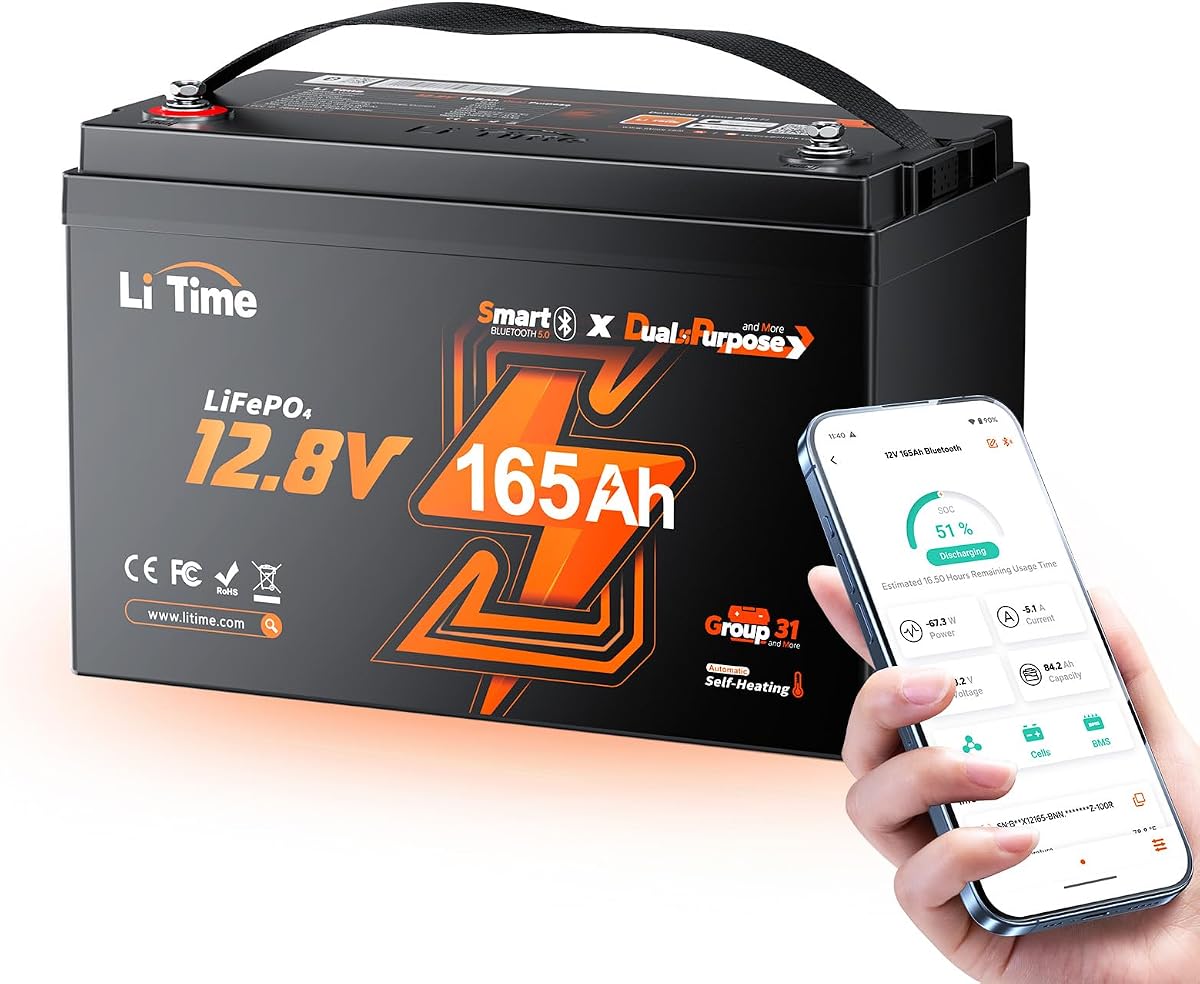
This dual-purpose battery replaces two separate units by starting outboard motors and powering accessories efficiently. It delivers 1200 CCA for reliable cold starts while offering a 165Ah capacity for extended house and trolling motor use.
We may earn a commission when you buy through this link, at no additional cost to you.
Auto-heating technology activates below freezing to ensure charging capability in cold weather. A 15% reserve cut-off prevents total discharge preserving enough power for engine ignition and safe return.
While it comes at a premium price the space and weight savings make it valuable for compact vessels. Owners avoid the hassle of managing separate start and house battery systems on board.
Ideal for boaters wanting an all-in-one solution this model simplifies electrical management significantly. It is a robust choice for those needing both high cranking power and deep cycle reliability.
One battery handles starting and deep cycling reducing weight and freeing up space in tight engine compartments.
Auto-heating ensures reliable charging and starting even when temperatures drop below freezing.
We may earn a commission when you buy through this link, at no additional cost to you.
MARSENERGY earns top marks for its reliable design and robust safety features including a sleep mode that cuts power during abnormal states. Low-temperature additives enhance cell resistance allowing safe operation down to extreme cold levels.
We may earn a commission when you buy through this link, at no additional cost to you.
Its compact Group 24 size fits standard boxes and weighs just twenty-one pounds improving vessel balance. The high rating reflects user satisfaction with its consistent performance and safety protections.
After a sleep mode event the battery requires manual activation to resume operation which may confuse some users. Despite this it offers exceptional longevity with up to fifteen thousand cycles at reduced depth of discharge.
This model is recommended for owners prioritizing safety and cycle life. It delivers efficient energy storage for marine and off-grid applications with minimal maintenance requirements.
Automatic power cutoff during faults prevents damage and ensures long-term reliability.
Internal additives improve low-temperature tolerance extending operational range in cold climates.
We may earn a commission when you buy through this link, at no additional cost to you.
Power Queen provides consistent performance with Grade A cells and a 100A BMS protecting against overcurrent and heat. Its Group 31 size offers slightly larger capacity and physical dimensions suited for varied power setups.
We may earn a commission when you buy through this link, at no additional cost to you.
Weighing around twenty-four pounds it remains significantly lighter than traditional lead-acid equivalents. The low self-discharge rate keeps the battery ready for long periods of storage without degradation.
Owners appreciate the smoother voltage output that benefits sensitive electronics on board. While heavier than Group 24 options it still delivers excellent weight savings and reliable power.
This battery is a solid choice for vessels requiring a robust house bank. It delivers stability and long-term value for marine and solar hybrid systems.
Grade A cells maintain stable voltage throughout discharge for smooth operation of electronics.
Minimal energy loss during storage ensures the battery is ready when needed.
We may earn a commission when you buy through this link, at no additional cost to you.
This model is built specifically for trolling motors with a built-in TVS protector to block voltage spikes in rough water. ABYC E-13 compliance ensures it meets marine safety standards for reliable operation.
We may earn a commission when you buy through this link, at no additional cost to you.
Featuring a Group 31 size it provides ample energy while being significantly lighter than lead-acid batteries. Low-temperature protection halts charging below freezing to safeguard the cells during cold weather storage.
The specialized design focuses on stability for fishing equipment and motors though it may cost more than generic options. Users value its durability and consistent performance during extended trips on the water.
Ideal for anglers prioritizing motor protection and compliance this battery delivers focused reliability. It is a strong choice for vessels requiring dedicated trolling power with enhanced safety features.
TVS surge protector ensures stable power delivery to sensitive electric motors and fish finders.
ABYC compliance offers certified safety for marine installations and electrical systems.
We may earn a commission when you buy through this link, at no additional cost to you.
Selecting the right lithium battery requires evaluating capacity size and safety features to match your vessel's electrical demands.
Capacity determines how long your battery can power devices. Most boats use 100Ah models for auxiliary systems while larger vessels may need higher capacities. Calculate your total amp-hour needs by listing all electronics and their usage hours.
Aim for a capacity that exceeds daily consumption by at least twenty percent to ensure reliability and longevity.
Check your existing battery box dimensions. Group 24 and Group 31 are common sizes for marine use. Lithium batteries are significantly lighter which can improve boat stability and fuel efficiency.
Ensure the new battery fits securely in the compartment and matches your terminal layout for easy installation.
A built-in BMS protects cells from overcharging short circuits and extreme temperatures. Look for units with robust protection including low-temperature cutoffs for safe operation in cold weather.
Prioritize models with proven BMS designs to avoid cell imbalance and extend overall service life.
Lithium batteries typically offer thousands of cycles. Compare cycle counts at different depths of discharge to gauge true longevity. A strong warranty indicates manufacturer confidence in product quality.
Choose options with at least a five-year warranty to protect your investment over time.
Bluetooth connectivity allows real-time tracking of voltage and temperature via smartphone apps. This feature is valuable for monitoring health during long trips.
Decide if wireless data is essential or if basic LED indicators suffice for your usage style.
Determine if you need a deep cycle battery for house loads or a dual-purpose unit for starting engines. Dual-purpose models combine high cranking power with deep discharge capabilities.
Select a battery type that matches your specific application to avoid performance issues.
Not all chargers work with lithium chemistry. Use a dedicated lithium charger or a compatible multi-stage charger to prevent damage. Some units work with solar controllers set to lithium mode.
Verify charger compatibility before purchase to ensure safe and efficient charging on board.
Marine environments expose batteries to moisture salt and vibration. Look for waterproof casings and BMS protection against dust and salt spray.
Choose units built for harsh conditions to ensure safety and durability in wet environments.
Proper installation requires secure mounting in a ventilated battery box. Connect terminals firmly and use corrosion-resistant materials to protect against salt exposure. Always ensure your charging system is compatible with lithium chemistry to prevent safety hazards.
Regularly check battery status using onboard monitors or Bluetooth apps. Keep terminals clean and free of oxidation to maintain efficient power flow. If storing the vessel for extended periods ensure the battery remains within recommended temperature ranges.
Avoid discharging the battery below the recommended cutoff level to protect cell health. Use low-temperature protection features if operating in cold climates. Follow manufacturer guidelines for charging rates and expansion connections to maximize cycle life.
Standard deep cycle batteries are not designed for engine starting. You need a dual-purpose model rated for high cranking amps if you plan to start your engine. Otherwise keep a separate starting battery for safety.
Yes you must use a charger with lithium settings or a dedicated lithium charger. Traditional lead-acid chargers can overheat or damage the cells. Always check your current charger compatibility before installation.
High-quality marine lithium batteries include protective BMS and waterproof casings. They are safer than lead-acid batteries because they do not vent harmful gases. Always choose units with marine certifications like ABYC compliance.
With proper care lithium batteries last ten to fifteen years. They offer thousands of deep cycles compared to hundreds for lead-acid. Cycle life depends on depth of discharge and temperature conditions.
Most models support expanding capacity by connecting up to four units in series or parallel. This allows you to build larger voltage or amp-hour banks. Use identical models and professional wiring for safety.
The BMS typically prevents charging below freezing to avoid damage. Discharge may also stop at extreme cold temperatures to preserve the cells. Look for models with auto-heating for reliable winter operation.
Bluetooth is useful for real-time tracking but not strictly required. Some models offer built-in indicators. Decide based on your preference for data visibility during trips.
Keep the battery clean and terminals tight. Avoid leaving it at low charge for long periods. Periodically check the BMS status and ensure the casing remains sealed against moisture and salt.
Choosing the right lithium battery involves balancing cost capacity and specialized features. Options like the Litime Group 31 provide marine compliance while others offer budget-friendly solutions for smaller setups.
Prioritize safety certifications and BMS reliability to protect your vessel and electronics. Whether you need dual-purpose starting or deep-cycle power there is a model for your needs.
Always verify current pricing and availability before purchasing. Prices fluctuate so check for seasonal deals to secure the best value for your marine power upgrade.